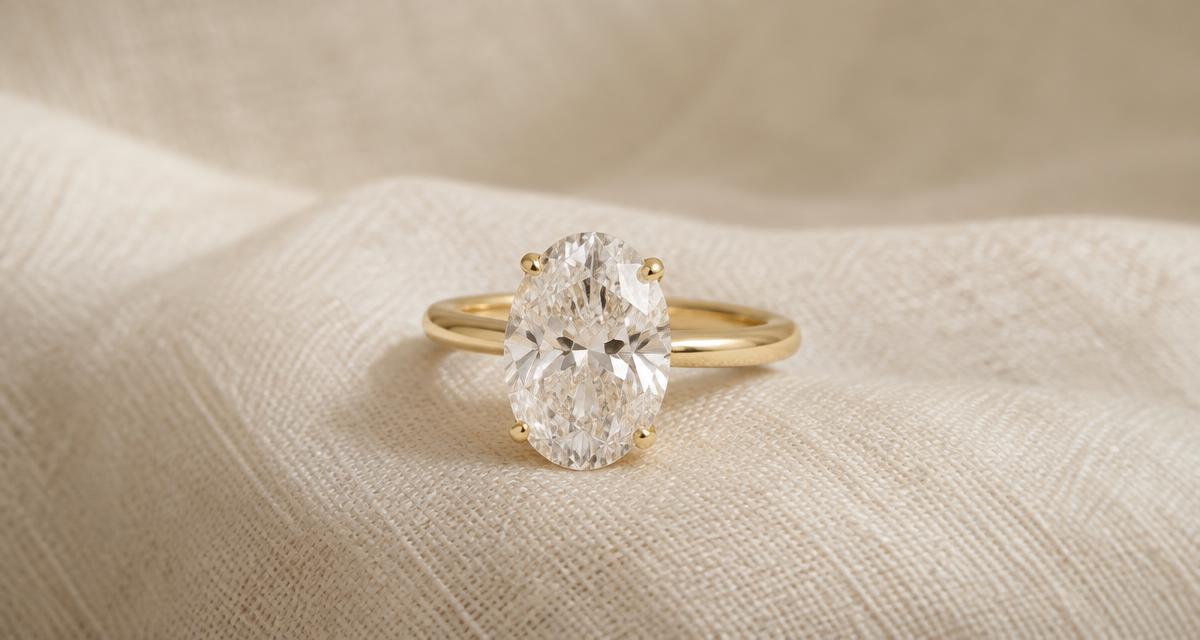
Ring styles · Oval

Oval engagement rings

Ovals are one of the most-searched engagement ring styles in the US. They look bigger than a round of the same weight, flatter the hand, and usually cost less per carat. Here is how to pick a great one.

Oval engagement rings

Choose your ratio

Ratio is length divided by width. Below 1.30 an oval starts to look round and stubby; above 1.55 it can look narrow. Size 1.40 to 1.45 is a popular sweet spot that reads as clearly oval on the finger.

Cut quality and the bow-tie

Ovals have no official cut grade, so judge them visually. Look for even sparkle from end to end and a light, soft bow-tie. A shallow stone spreads wider but leaks light; a very deep one hides weight in the base.

Color and clarity for ovals

Elongated shapes show color a little more at the tips, so G–H is a safe natural choice in white metal, and I–J can look warm and lovely in yellow gold. VS2–SI1 clarity is usually eye-clean in ovals.

Popular oval settings

The four-prong solitaire, the hidden halo, east-west (sideways) settings, three-stone with pear sides, and thin pavé bands are the most common oval designs. Try each in the True Carat 3D designer to compare the look and price.

Common questions

Why are oval engagement rings so popular?

An oval looks larger than a round diamond of the same carat weight because more of its weight sits in the visible top surface, and its elongated outline makes fingers look longer. It also usually costs less per carat than a round brilliant.

What is the best ratio for an oval diamond?

Most buyers prefer a length-to-width ratio between 1.35 and 1.50. Around 1.35 looks classic and balanced; 1.45 to 1.50 looks slimmer and more elongated.

What is the bow-tie effect?

A dark band across the middle of an oval caused by light leaking out. Almost every oval has some bow-tie; choose one where it is faint and only visible at certain angles, which means checking photos or video rather than the grading report alone.

Which setting suits an oval diamond?

A four-prong solitaire keeps the focus on the stone, a hidden halo adds sparkle from the side, and a pavé band or three-stone setting with pear or tapered side stones adds width and presence.

How much does an oval engagement ring cost?

As a rough guide, a 1 carat oval natural diamond ring often lands in the low-to-mid thousands of dollars and a lab-grown equivalent far less. Use the True Carat calculator for an estimate based on your exact choices.